The 2025 Electronic Cash Conference (ECC) has come to a close, and I thought I’d share my thoughts. To be honest, I really wasn’t sure what to expect going in. Both in terms of how the conference would go, as well as what impact, if any, it would have on my personal feelings about the eCash project.
I also admit a part of me couldn’t help but speculate on whether or not the conference would have an effect on the price of XEC. Would it serve as a launchpad for XEC to finally pump? Or maybe it would have the opposite effect, either because we didn’t get the good news we were hoping for, or because the good news came and went and it felt like there was nothing left to look forward to. Mostly, I suspected the price would just stay the same, because as the saying goes, nothing ever happens.
Well, we got the good news, and the price has pretty much stayed the same. So where does that leave us?
Full disclosure, my initial response after the conclusion of the presentations was one of disappointment. Not because of the lack of a market reaction, but for another reason that I’ll explain later. It also probably didn’t help that by the end of the conference I was running on fumes. It started at 12:30 am my time, ended at 8:00 am, and to top it all off, I had to take my son to his soccer match by 8:15.
Behind the paywall I briefly go over what each of the presenters discussed, my impressions of their talks, as well as my general feelings and observations about the conference overall. I hope you will find it’s well worth the 1000 XEC.
First off, the ECC took place between October 4-5 in Barcelona, Spain. The Friday evening prior to the start of the conference, in-person attendees got an opportunity to meet their fellow attendees and have dinner together. Those who purchased online tickets got access to the streams through the Gather.Town app where we could not only watch and listen but also ask questions. (On a sidenote, I commend the organizers for being one of the few, if not the only crypto conference, that allowed people to purchase tickets using crypto. Anyone who wanted to purchase a ticket could do so without providing their credit card number, or any other identifying information, and using the PayButton plugin was fast and smooth.)
Based on what I could see on the stream, there appeared to be about 20 people in attendance at the actual venue, with maybe another 10 people attending online. While this is a far cry from crypto conferences like Token 2049 that have tens of thousands of attendees, comparing the ECC to Token 2049 wouldn’t make sense since they serve very different purposes. The latter is an event that caters to the entire crypto industry and is run more like a huge music festival with multiple stages and a heavy emphasis on the investment (aka shilling) side of crypto.
The ECC on the other hand, besides being a much more intimate affair, is focused on crypto as electronic cash, meaning the event was more catered to developers and engineers interested in discussing the technical, rather than speculative, side of blockchain.
(Before I start, a big shoutout to Nate Novosel, who live tweeted the entire conference and took great notes while watching from the east coast. I leaned heavily on his efforts in order to put this together.)
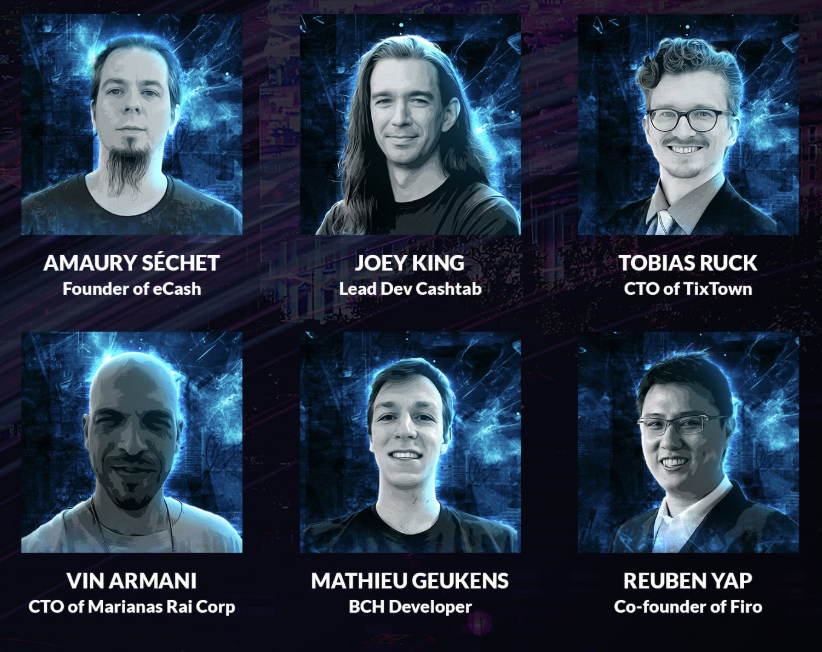
The first presenter was Vin Armani whose talk was titled “Why eCash Is the Best Network for Stablecoins”. He started by making a case for why stablecoins are the killer app of crypto, and explained how going from once having stablecoins on Bitcoin, to moving them to Ethereum, was a step backward. His argument was that the UTXO model is superior to the account model when it comes to peer-to-peer digital cash. Not only because it’s so much easier to scale, but also because it allows us to do some interesting things. For example, one of the biggest drawbacks of having stablecoins on ETH is that in addition to the stablecoin tokens themselves (i.e. USDT, USDC, etc.) you also need ETH to pay for gas fees. One potential solution to this problem is going through custodians, because if an exchange holds your tokens, they can cover the gas fees for you.
But the problem is this kind of system kills the freedom aspect of crypto. By being forced to use custodians, it goes directly against what Satoshi wrote in the Bitcoin whitepaper. This is big reason why Vin’s company is building their MUSD stablecoin on eCash. One, because eCash makes it possible to have tokens that can be sent gaslesesly, and two, because the eCash network also offers a robust tech stack and a scaling roadmap that ensures his project will have a stable foundation to grow on top of for years to come.
As for Vin’s MUSD project (the first stablecoin issued by a US government entity), they are still ironing out some details with Tinian’s attorney general before they can move forward. Vin also revealed they’ve already built a wallet and have some ecosystem partners in waiting so they can hit the ground running once those issues have been resolved, hopefully at the end of this year, or the beginning of next.
Finally, towards the end of his presentatio, Vin also mentioned how his support for eCash and Bitcoin ABC went beyond technical reasons. He said it was more like Deuteronomy, because while so much of the rest of crypto is evil, Bitcoin ABC is not. I couldn’t agree more.
When I first heard that Mathieu would be a speaker, I was a bit surprised since he’s a well known Bitcoin Cash developer who worked on BCH’s CashTokens, CashScript, as well as his own stablecoin project ParityUSD. But considering the conference was officially called the Electronic Cash Conference, not the eCash Conference, I went into his presentation titled “Unlocking the Power of Bitcoin Script” with an open mind.
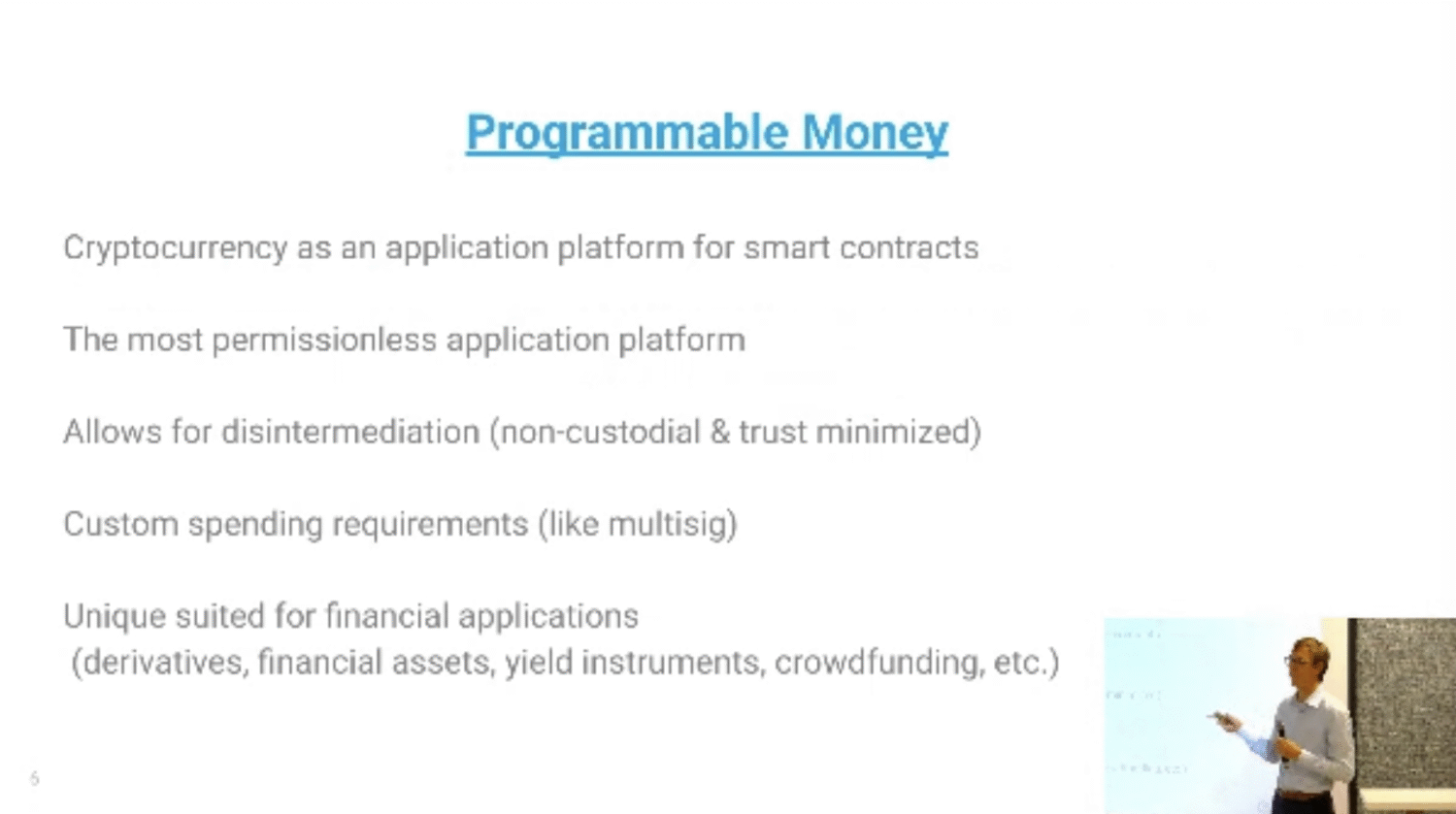
Mathieu’s core assertion was that the script system is the most interesting part of Bitcoin and all of its forks. This is because he sees cryptocurrency as a permissionless application platform for smart contracts. It allows for disintermediation (non-custodial and trust-minimized), custom spending requirements (like multisigs), and is uniquely suited for financial applications.
But in order for Bitcoin, or eCash, to take advantage of these properties to power smart contracts, we would have to make various changes like reactivating old op_codes, as well as create accessible, high-level tooling. Though Mathieu’s talk was quite technical, I got the impression that he is very knowledgeable about the subject matter and his proposal of coming up with a standard CashVM to counter the EVM was intriguing. It made me hope that more talented developers like Mathieu, if not Mathieu himself, would consider joining the eCash project and help contribute to its future.
Tobias’s talk was titled “New Transaction Format: For or Against”. Tobias is the creator of the Chronik indexer, and the founder of the event management platform TixTown, and his presentation was also a technical talk where he gave his reasons for wanting to implement a new transaction format in eCash. Tobias explained how it would improve efficiency, fix long-standing issues, and add new capabilities such as allowing bi-directional trades on Agora.
Currently, you can only place token sell orders in Agora, but this new transaction format would allow you to place buy orders as well. He also introduced other possible new features such as Transaction Introspection Opcodes, Flexible Transactions, and Preambles. The latter would enable Preamble Tokens that would “add minimal primitives to make convenient tokens without committing to a protocol”. He concluded by laying out the different options of how we could implement these changes by leveraging a testnet, a signet, or even an Avalanche subnet.
While a lot of what Tobias said went over my head, his proposal seemed well thought out and considered. I came away excited about the possibility of getting buy order functionality in Agora, as well as the incremental efficiency improvements his proposal could deliver.
This was probably my favorite talk from the conference, perhaps due to it not being a technical talk but one that offered a big picture view of the current state of crypto. Titled “Darkest Before the Dawn: Unstoppable Small-Caps in an Age of Memes”, Joey weaved together various threads including the Spanish Civil War, an ancient Greek navy, the rise of memecoins due to a crisis of meaning, and the overall mission of crypto.
Joey is the lead developer of the Cashtab wallet, annd he feels that crypto today is easily the most embarrassing industry. He pointed out how it was dominated by speculation while having very limited real world impact. I couldn’t help but nod along as he spoke. In fact, I’d recently been toying with the idea of talking to leaders at my own company about coming up with a crypto strategy, but Joey’s talk has made me reconsider.
He also explained how retail isn’t interested in the technology of crypto, and that memecoins are not new, that they are a symptom, not a cause. He pointed to the $52B market cap of Chipotle as an example of this, and I found myself laughing out loud when he alluded to the technology that is the burrito.
What I think he meant about memecoins being a symptom, not the cause, is that the memecoin phenomenon doesn’t represent a paradigm shift, but merely a signal that our incentives are broken, because our money is broken. What we need to do is fix these incentives by fixing our money, which can help reduce the amount of malinvestment we see in the market today.
He also contended that the impact of the Internet is massively under appreciated, and we are only beginning to see its impact on things like money. Though its true that the internet has changed our lives significantly, I can see how we may have only scratched the surface of what the Internet makes possible.
The bottom line is that while memecoins can undergo speculative price appreciation, they rarely, if ever, can survive a price collapse. Meanwhile, mission driven projects like eCash can keep building momentum even when the price is down to ultimately remain as the last man standing.
To illustrate this point, Joey brought up a story from ancient Greece known as The Silver of Laurion and Themistocles’ Vision. I had to look this up afterward, but around 483 BCE, the Athenians found a new rich silver mine. According to tradition, the Athenian Assembly debated what to do with this sudden wealth. Some citizens wanted to distribute the money directly to the people as a sort of dividend, but the statesman Themistocles argued that Athens should invest it in building a powerful navy. While the creation of this Athenian fleet was extremely costly, it ultimately enriched the city of Athens and more than paid for itself by transforming Athens from a land power to a naval superpower. It saved them from Persian invasions, secured Athens’ independence and future dominance by protecting trade, bringing wealth, and funding cultural achievements like the Parthenon.
In conclusion, while it may be true that memecoins have seen short-term exponential growth in the past, non-speculative use cases can experience sustainable exponential growth that can survive price collapses in a way that memecoins typically can’t. By focusing on solving real world problems, improving the user interface in terms of simplicity and ease of use, a mission driven project like eCash can outcompete the legacy systems that are trending in the wrong direction and push through the “memecoin nihilism” to kickstart a golden age for crypto and the world beyond.
Amaury’s talk was titled “Overview of Upcoming eCash Features” and the one I was most looking forward to at the conference. Considering how much I’ve enjoyed his talks in the past, and the fact that it’s been several years since he’s done one, it’s easy to understand why.
Adding to my expectations was the fact that his talk was also billed as the keynote address for the weekend. But unfortunately, for me at least, everything he talked about was already familiar to me. With that said, I will recap his talk here for others hearing it for the first time.
He started his presentation by explaining that in order to talk about where we are, he needed to tell us about the steps that came before. He started by describing the various scaling challenges facing blockchain technology and the solutions the eCash project is leveraging to solve those challenges. This included getting rid of the need for ordering data, using the Avalanche protocol to both reduce confirmation times from minutes to a couple seconds, as well as helping eCash scale to millions of transactions per second so the network doesn’t crumble under significant usage.
I recognized many of his slides from his past presentations, including the one where he shows how nodes typically sit around doing nothing for ten minutes, and then when a new block is found, they’re suddenly forced to do a ton of work. What the Avalanche protocol does is allow these nodes to talk to each other in between blocks and spread out the work over time, rather than having to wait until a new block is found, thus reducing the amount of data that has to be transferred in a short period of time.
He also gave several more examples of how integrating Avalanche benefits the network. Such as 51% attack prevention, more consistent block times, dynamic transaction fees, and the ability to reach consensus through the protocol rather than through debates on social media (i.e. Core v. Knots).
He concluded his presentation by announcing that Avalanche pre-consensus was coming to the eCash network in the next scheduled upgrade, November 15, 2025. This was indeed the good news many of us had been waiting for, and yet, rather than be excited, I couldn’t help but feel a bit disappointed by the end of his presentation.
Maybe it was because I was exhausted from having stayed up all night waiting for his talk. Maybe it was because none of the information he shared was new for those who have been closely following his work over the years. Or maybe it was because he literally yada yada yada’d his way through portions of his deck.
This isn’t meant to take anything away from Amaury and what the Bitcoin ABC team has achieved. Just as Mathieu thanked Amaury at the start of his presentation for creating both Bitcoin Cash and eCash, I too am thankful not only his contributions, but also all the wisdom I’ve gained from listening to his talks and interviews. But as he once said, people get mad (or in this case, disappointed) when their expectations don’t match reality, and I guess you could say I was expecting more. I fully understand that he might be disinterested in presenting something he’s been over countless times already, and I’m certainly glad he isn’t up there like Arthur Hayes at Token 2049 shilling everyone that it’s time to “full send”, but I was looking forward to learning something new from his presentation, and that didn’t happen. I hope this doesn’t get taken the wrong way. I’m not writing this to put Amaury down, but to be honest.
Reuben was the final presenter at ECC, and his talk was titled “The On-Chain Privacy Landscape and Beyond”. Reuben is the co-founder and project steward of the FIRO blockchain (previously known as Zcoin). During his talk, Reuben went over the privacy landscape in general, covering topics such as the technical and regulatory challenges, why we need financial privacy, some myths about privacy, and what onchain privacy means:
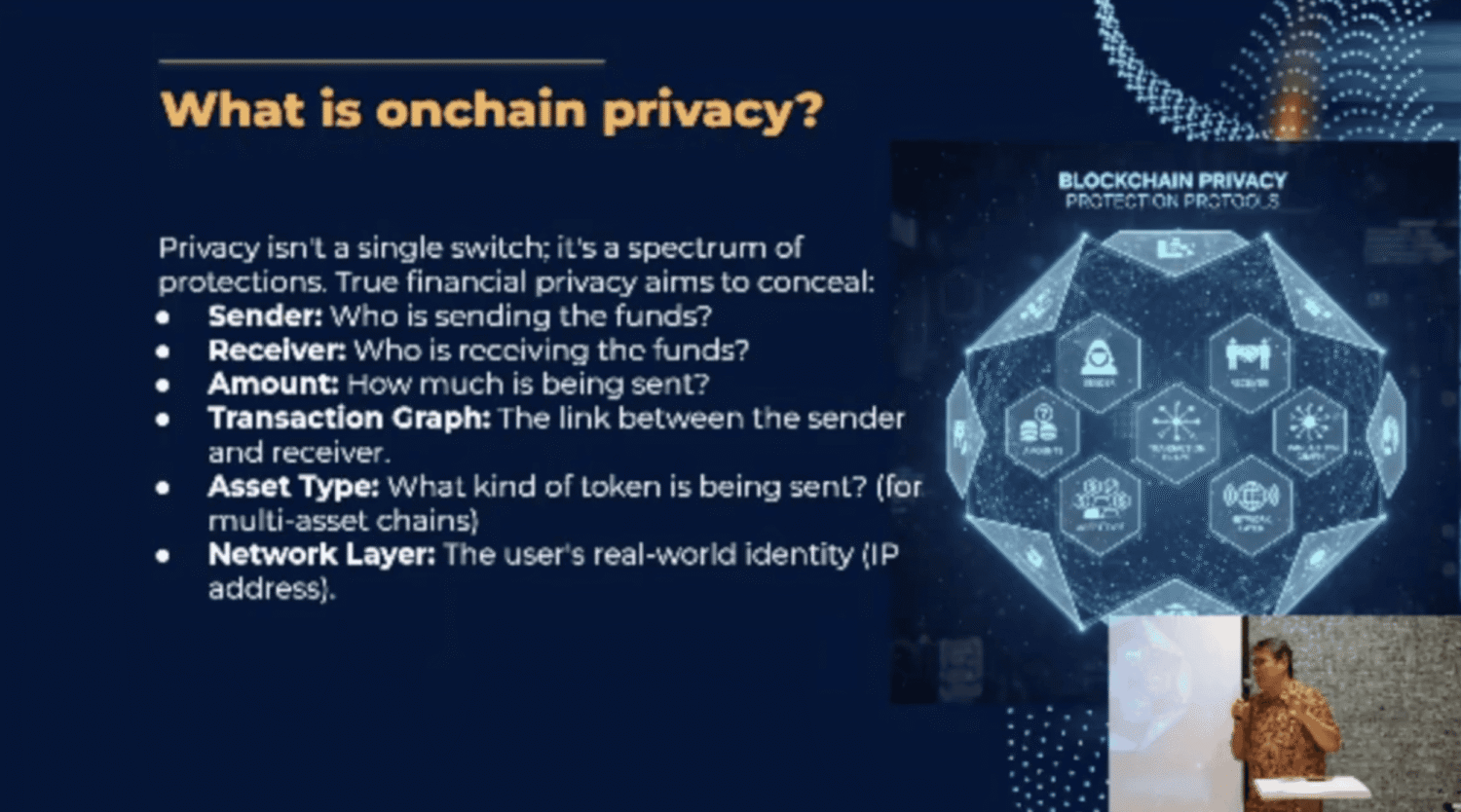
- Privacy isn’t a single switch; it’s a spectrum of protections.
- True financial privacy aims to conceal:
- Sender
- Receiver
- Amount
- Transaction Graph
- Asset Type
- Network Layer
He provided examples of the different privacy strategies employed by projects like Monero (ring signatures), Litecoin (mimblewimble), Bitcoin (coinjoins), Zcash (zero knowledge proofs), and Firo (lelantus spark). He explained how they each work, and their advantages and disadvantages. His presentation provided a great overview of the privacy landscape in crypto and I learned a lot about not only privacy technology, but the regulatory landscape, and how it colors what exchanges are looking at when deciding to include a certain privacy coin or not.
As with all the other speakers, I was impressed by Reuben’s knowledge and presentation skills. And just as I felt at the end of Mathieu’s talk, I couldn’t help but wish Reuben could join the eCash project and develop an eCash privacy subnet.
(As an aside, I actually didn’t get to watch Reuben’s presentation live because I had my aforementioned kid’s soccer game I had to go to. But it turned one of our eCash community members actually streamed it on X, so I got to watch it at home afterwards. It made me hope that next year the organizers can make all the presentations available in this way so as many people as possible can watch the streams for free rather than charging people for online tickets.)
That concluded the presentation portion of the conference, at which point Antony Zegers, CEO of Bitcoin ABC, came up to talk about the rest of the weekend and the evening’s dinner plans. Off camera Amaury must have suggested meeting earlier so Antony joked, “The benevolent dictator has decided we’ll meet at 8 tonight. We must follow our leader!”
Seeing this hours afterward, after having logged off feeling a bit disappointed with Amaury’s talk as I took my son to his soccer game, I couldn’t help but smile at this interaction. It reminded me of what a great team of people we have leading this project who not only share similar values and vision, but genuinely seem to like each other as well. That combined with a long nap, the great presentation given by Reuben, not to mention my son’s soccer game, all acted as a sort of palette cleanser that left me feeling no longer disappointed but reenergized about the future of eCash.
Conclusion
Now that the ECC is over, I can confidently say that eCash supporters are extremely fortunate to have such brilliant minds leading this project. Take one look at the agenda for Token 2049 and you will see the stark contrast between what was presented there, versus at this year’s ECC. Overall, I would consider the 2025 conference a major success. Hats off to the team on pulling it off and everything going off without a hitch. I literally had fomo not being there since all ticket purchasers got to join a private telegram channel where we got a glimpse of some of the activities the in-person attendees participated in. Restaurants, bars, and even a group photo in front of the Sagrada Familia Cathedral still under construction after all these years. (There has to be a metaphor in there somewhere, right?)
eCash supporters have a lot to celebrate and look forward to. Besides the the announcement of Avalanche pre-consensus launching in just over a month on November 15, 2025, we just launched the new e.cash homepage and I personally think it’s easily the best landing page in all of crypto. The ECC served both as a reminder of why I chose to invest in and support XEC, as well as a celebration of everything they’ve built so far, and a glimpse ahead to everything they plan to build in the future.
The price of XEC may not have gone up yet, but it’s capabilities certainly have, and I can’t wait until November 15 to see which exchanges will be the first to adopt instant deposits for eCash.
A big thank you to the organizers, the presenters, and everyone else who contributed. Also, thank you again to Nate Novosel for taking such great notes. I recommend reading his thread if you want more of the actual content that was shared in the presentations.
Finally, if you were fortunate enough to attend the conference in person, please leave a comment. I would love to hear from someone who was there and what your takeaways were.
Oh, and one more thing, if you haven’t already done so, or even if you already have, take a look at the new video that premiered at the end of the conference. It not only explains why eCash exists, but it is well worth the watch for some of the imagery alone. Everyone in crypto needs to watch this and hear its message.
awesome as usual 🙂
very technical. Ordinary people really don’t understand. CZ should also be invited by the eCash team😅😅
Thank you for sharing.
I also appreciated Joey’s talk the most for the reasons you described. What does all the tech matter if it is not solving real-world problems?
It was great to meet everybody in person and finally put a real 3D face to all the pseudonyms I’ve interacted with over the years. I wish I could have met you as well, because as I did with Joey, I know that meeting you would have helped me realize even further that eCash and Lotus are not competitors, nor are either project acting towards each other at cross purposes.
We all have the same dedication and drive to our separate but complementary missions to help make the world a better place.
Thank you 🙂
I was able to attend! What I liked most were the friends we made along the way 💪