Since Zcash is pumping and in the news, I thought it would be interesting to compare Zcash v. eCash, ZEC v. XEC. Some might say this is cope, but I call it research. Pay 1000 XEC to unlock the paywall…
For those who are unfamiliar, the Zcash project was launched in 2016 and its genesis block was mined on October 28, 2016. The eCash project, on the other hand, was forked from Bitcoin Cash on November 15, 2020, and officially launched on July 1, 2021, with its genesis block being the same as Bitcoin’s mined on January 3, 2009.
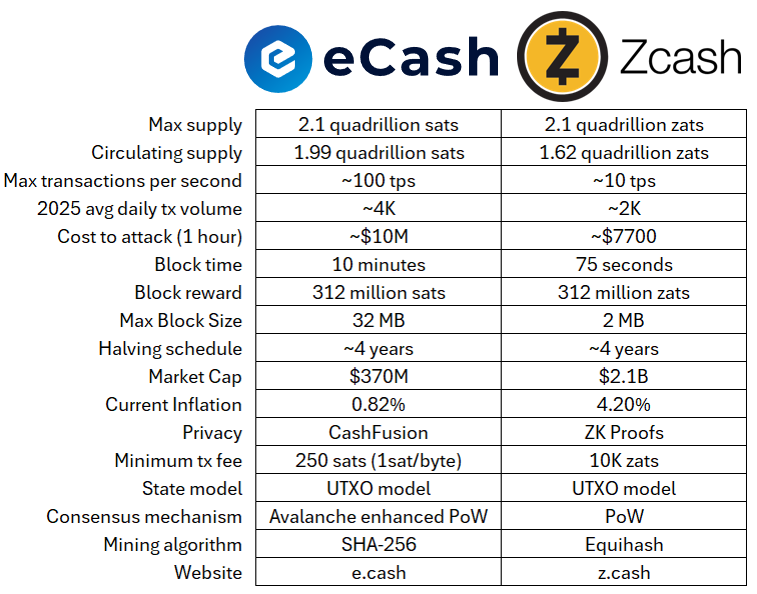
At a high level, Zcash and eCash actually share quite a few similarities. For example, the max supply for both chains is 2.1 quadrillion satoshis, they both share the same 4-year halving schedule, share the same UTXO model, and incorporate a self-funding mechanism, but there are many key differences that set these two projects apart. Let’s tackle them one at a time.
Core Purpose
While both chains are aiming to be a version of peer-to-peer electronic cash, ZEC differentiates itself with added cryptographic privacy via zero-knowledge proofs. Users can choose between transparent transactions (like Bitcoin) or shielded transactions (which hide sender, receiver, and amount).
On the other hand, eCash is optimizing for low fees, scalability, and fast payments, while tackling privacy through its CashFusion protocol (an advanced form of coin mixing), with future plans of adding a zero-knowledge subnet that would give users the same level of privacy offered by Zcash. (The advantage of relying a privacy subnet is that the entire UTXO set remains transparent and auditable for eCash, which is not the case with Zcash, forcing users to trust cryptography audits to protect against hidden inflation.)
Roadmap
Bitcoin ABC, the team currently leading the eCash project, has had a well-defined roadmap since its inception that is focused on scaling the network from its current 100 transactions per second, to 5 million transactions per second. With key roadmap items including Avalanche pre-consensus, Merklix-Metadata tree for scalable block processing, and the activation of subnets, the developers are on a mission to make sure eCash is scalable, extensible, and usable for every human being on the planet.
The development team leading Zcash, Electric Coin Company, takes a much different approach with regard to their roadmap: “The ECC roadmap will be updated quarterly, along with objectives and timelines, and we welcome your participation. If you have skills that can help us, we’d love to work with you. Twice a year, we’ll invite Zcash community developers to meet with us in person, to help us plan and adapt.”
This could explain why Zcash was rewritten 3 times from scratch, which doesn’t seem ideal.
Transactions
Currently Zcash can handle ~10 transactions per second while eCash can do an order of magnitude more, or ~100 transactions per second. XEC has stated the goal is to achieve 5M txs/sec, but no comparable target has been mentioned for ZEC. Given the complexity of Zcash’s shielded transactions, it is unlikely their network can scale to the degree that eCash can. Also, transaction fees on XEC are as low as 250 sats, whereas the minimum transaction fee on ZEC is 10,000 sats, a 40x difference.
In terms of daily transaction volumes, XEC and ZEC had similar levels of activity in 2025 with approximately 4000 and 2000 transactions per day, respectively, until the recent spike in ZEC price led to its transaction volume overtaking XEC’s previous lead.
Security
Because ZEC is a pure Proof of Work chain, it is susceptible to 51% attacks. It is estimated that attacking the network for 1 hour would cost roughly $7700. By comparison, eCash is secured by both Proof of Work and Avalanche consensus, making it virtually impossible to attack the network in a similar fashion. You would need both mining power and have many millions of dollars of staked XEC to even attempt such an attack, versus only having to rent enough hash power to attack ZEC.
Ecosystem
Despite Zcash having had a 5-year head start on eCash, I have found that the eCash ecosystem has much more going for it. For example, the block explorer on eCash is faster and more polished. In my opinion, the e.cash landing page is far superior to z.cash. But also, there are already several native eCash applications such as BlitzChips.com, PayButton.org, hodlwars.com, stakedxec.com, firma.cash, that allow you to actually use your XEC onchain. While ZEC may currently have a larger network effect due to it being available on more exchanges and crypto payment processors, that can change quickly if eCash catches on since it would be easy for any platform that accepts Bitcoin to add eCash due to it being a Bitcoin fork.
Wallets
Both XEC and ZEC are supported by multiple wallets, but the flagship wallet for eCash is Cashtab, while the equivalent wallet for Zcash appears to be Zashi. One clear difference between the two is that Zashi is an app wallet versus Cashtab being a web wallet, though an app version of Cashtab is on its way. Another difference is that Cashtab has many more features than Zashi. You can mint and trade tokens, send airdrops, mint and trade NFTs, create multiple wallets, and more. Zashi’s features are more basic and limited to sending and receiving ZEC.
Overall User Experience
I am obviously biased in favor of eCash over Zcash, but I think that bias is justified. Only a couple of years ago, using the Zcash network was all but impossible due to a prolonged denial of service attack that took the team more than a year to solve. While the eCash network has already implemented Avalanche post-consensus backed by proof of stake, with pre-consensus well on the way, the Zcash team is still discussing moving to proof of stake with no timetable of when it would be completed. As someone who has actually used both networks, I think the difference in UX is substantial, and I expect the gap to only widen as time goes on. The paywall feature on this blog is a perfect example of something that can easily be built in the eCash ecosystem but not in the Zcash ecosystem.
I’m sure Zcash supporters will ignore everything I’ve written above by pointing at the recent price action of ZEC compared to XEC, but whether or not that stays true in the long run is anyone’s guess. And don’t just take my word for it. Get your hands on a little XEC and ZEC and compare the experiences of using them both. Staring at charts isn’t research, no matter how much the price pumps.
Thank you for reading. Below is a table that highlights some of the differences and similarities between XEC and ZEC:
If you enjoyed this article, please send a link to others (along with some XEC), so they can experience using cash for the internet themselves.
Nice comparison.
In my own research I also compared coins based on: hardware wallet integration, smart contract possibilities, number of nodes, merchant adoption, number of developers and their competency, development funding amount, development culture and principles.
I should have included the hardware integration factor in one of the sections, as well as your other points. Would love to know how many ZEC nodes there are if you know the answer. Also, what’s your take on developer competency, culture and principles between the two teams?
Zcash has 1729 nodes according to https://blockchair.com/zcash/nodes
10 times less activity on their repository (https://www.cryptomiso.com/)
I also remember Zooko talking in an interview about a critical bug that they had for a long time. When he found out about it, they decided to wait for their regular update before disclosing it.
I assume they made a wrong design decision to integrate anonymity at the base layer which complicates their job. So, I think their devs are competent but not good engineers.
The way they split the developer funding seems a a little too bureaucratic. The fact that Zooko is no longer leading the project doesn’t inspire confidence. I like they contacted Snowden for their initial secret key generation, and their focus on privacy but I think they sacrifice scalability which hinders mass adoption.
Thanks for the info. I always thought the whole ceremony when they started seemed hokey but I never looked too closely into it. The fact that zcash was rewritten 3 times from scratch also doesn’t instill confidence even though they think it’s something to be proud of: https://x.com/zcash_community/status/1973342459863376045