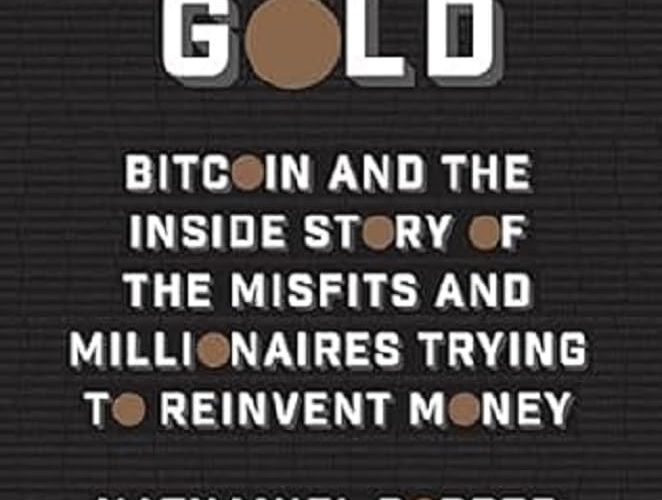
The other day I was going to write an article comparing the early days of Bitcoin, to the early days of Bitcoin Cash and eCash. But I realized that while I’d been around for the early days of BCH and XEC, I’d only heard stories about the early days of BTC.
That’s what led to me buying a copy of Nathaniel Popper’s book, “Digital Gold: Bitcoin and the Inside Story of the Misfits and the Millionaires Trying to Reinvent Money”.
Honestly, I wasn’t expecting much, but of the five crypto books I’ve read, this was easily the best by far.
Why?
Because it tells the amazing story of Bitcoin in the best way possible. I think what I appreciated was how the author finds a way to weave the story of Bitcoin’s early days, with the basics of how the technology works, and why it matters.
Take, for example, this passage from the very first chapter, demonstrating the author’s understanding of Bitcoin in a way that many others don’t.
“Cold, hard cash had long provided an anonymous way of making payments, but this cash did not make the transition over to the digital realm. As soon as money became digital, some third party, such as a bank, was always involved and therefore able to trace the transaction.”
But more than the author’s brief explanations of the properties of money, the gold standard, and fiat currencies and their debasement, what I was most impressed by was the amount of research he had done on the colorful cast of characters who were there at the very beginning of Bitcoin.
Considering the origin story of Bitcoin might be the second greatest origin story of all time, I am happy to say Mr. Popper does the story justice. At times, it felt like I was reading about an ancient epic as I was introduced to names that are famous in Bitcoin lore like Martti Malmi, Gavin Andresen, Jed McCaleb, Mark Karpeles, Ross Ulbricht, and plenty of others. Each one is brought to life as you get a glimpse into their personalities and the roles they played.
There were moments that made me wonder what Satoshi must have been thinking at the time. For example, I found it interesting that Satoshi asked Gavin to have his email replace Satoshi’s own email on the Bitcoin.org website, but left the site itself to Martti.
It was fascinating to see a version of Roger Ver that I wasn’t familiar with since I only know the version of Roger after Bitcoin Cash. Learning about the early days of Mt. Gox and Silk Road were like mini-movies in and of themselves. And of course I couldn’t help but compare what that period was like to these first four years of the eCash project, but that will have to wait for my next article.
“Digital Gold” is the story of how Bitcoin could have died but survived. It takes you on a journey from 2009 to 2014, as Bitcoin went from $0 a coin, to over $1000 a coin, and its supporters went from a group of excited and enthusiastic misfits, to newly minted millionaires who believed they were on top of the world.
nice one, hope the author jumps in for a read.
लेकिन बीटीसी को तो इलेक्ट्रॉनिक कैश बनना था डिजिटल गोल्ड बन गया !
History is so important. From it we learn what to jettison, what to retain, and what to revive.
In the current crypto space – which is badly in need of a compass – knowing the history of Bitcoin is perhaps more important than ever.
Those who support the eCash project have a kind of ease that stems from the knowledge that eCash is true to the legacy of the Cypherpunks and OG Bitcoin days. It’s now just a question of: when will the crypto space as a whole get back to its roots?
eCash is sound Mony