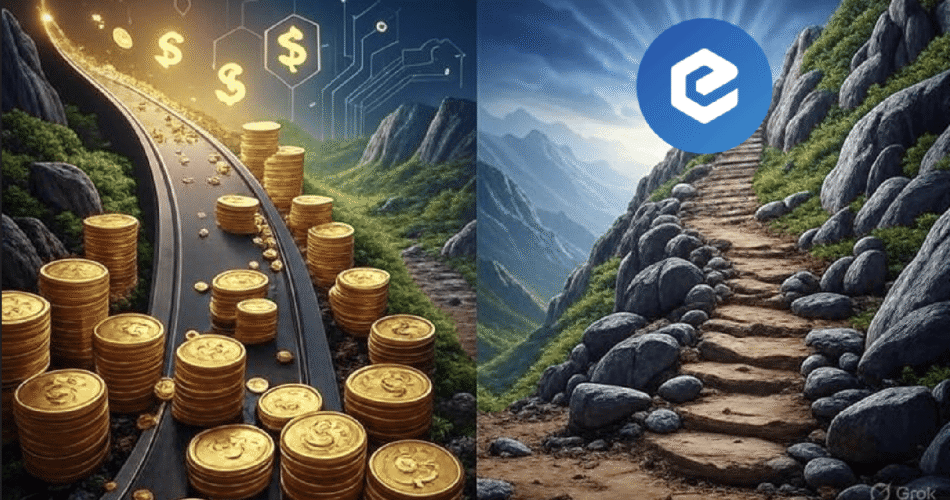
You’ve probably heard the phrase the path of least resistance. It’s a saying that can have different meanings. For example, it might be used in reference to people who like to take the easiest option, who avoid struggle and conflict. This can be interpreted as laziness or complacency.
But the path of least resistance could also be interpreted as a way to avoid wasting effort fighting unnecessary battles, or choosing simplicity over needless complexity, which can be interpreted as wise and efficient.
Either way, whether it’s due to laziness, or wisdom, I believe most of us tend to choose the path of least resistance. Of course that isn’t to say all of us, and there are also certainly degrees to how hard one is willing to work, or how lazy we want to be, so we need a way to help us decide how much resistance we’re willing to take on.
How?
With money. Money serves as the incentive mechanism to make us do things that we find hard. We work, to make money, to afford to live the way we want to live. In turn, our work produces value for others, who pay for that value with the money they’ve earned from their work, and so on.
Money is literally what makes the world go around. It helps us coordinate as a society, to build things people want and need more of in the world. Money isn’t evil, money is a tool. But lately that tool seems to be becoming more and more corrupted, more unsound.
Politicians get rich, pharmaceutical companies get rich, defense companies get rich, while people suffer. Instead of our money being used to help us produce more of what we value in the world, our money is all too often used to fund things like wars, disease, and injustice.
I believe Bitcoin was created to fix our money again, because money is too important not to fix. But rather than doing the hard work of scaling Bitcoin so it can be used as money for the world, its so-called leaders have for a long time chosen the path of least resistance.
They choose to keep the block size limit at 1 MB, to not introduce new op codes, or make any other significant changes to the code, while marketing the hell out of it as digital gold, not digital cash.
So was this strategy successful?
It’s clearly been profitable if you’re talking in terms of accumulating the most dollars. You might even say it was the path of least resistance.
But like I said, not everyone is the same. The eCash developers, unlike the Bitcoin developers, have taken what can be called the path of most resistance, because they understand a Bitcoin that is only good as a store of value, isn’t Bitcoin.
Back in 2017, when it was clear the Bitcoin Core developers were going to keep the block size limit at 1 MB and only introduce the Segwit part of Segwit2x, Bitcoin ABC, founded by Amaury Séchet, and helped by Bitcoin ABC’s current CEO Antony Zegers (among others), put in the work of writing a new client that would activate a Bitcoin fork with 8 MB blocks, while also coordinating with miners, and exchanges, and dealing with everything else that must be considered in a chain split, something that had never before happened in the history of Bitcoin.
For more than three years, starting from the the time of the Bitcoin Cash fork on August 1, 2017, Amaury and the Bitcoin ABC team led the Bitcoin Cash project. They worked with every major exchange and payment processor to integrate BCH, providing not only their technical expertise, but also working on the protocol at the same time. For over three years, they acted as good stewards of the project, dealing with bugs, with the community, and the industry at large.
But when Bitcoin ABC let everyone know that they were running out of funds to keep operations going, rather than rally around them, the community turned their backs. At this point Bitcoin ABC could have easily closed up shop and moved on. They could have said goodbye to the community and wished them luck without their services.
But that’s not what they did. Instead, they gave the market a choice. They announced they would be including a new rule that required anyone using their client to mine Bitcoin Cash to send 8% of the block reward to an address they controlled. Half of the 8% would go to fund Bitcoin ABC’s operations, and the other half would be stewarded by a group of proven XEC stakeholders called the Global Network Council, or GNC.
The vast majority of the BCH community acted as if Bitcoin ABC had just killed someone. They called the IFP a tax, even though it was a voluntary payment miners could simply opt out of by not using ABC’s open source software.
Eventually a team forked Bitcoin ABC’s code and created a new client, BCHN. It didn’t include the IFP rule, so on November 15, 2020, the miners that ran Bitcoin ABC forked away and created a new chain, that would later be named eCash.
Considering how few miners supported Bitcoin ABC, it was a miracle they survived, that miracle being their work on what we now know as Avalanche post-consensus, a revolutionary new technology that allowed a minority chain to fend against 51% attacks.
For the past five years, Bitcoin ABC has worked tirelessly on the eCash protocol to turn it into the best payment network in the world. They’ve managed to successfully accomplish things I can’t even begin to understand. Avalanche post-consensus, staking rewards, an in-node indexer, the heartbeat algorithm, the agora dex, and of course, the imminent launch of Avalanche of pre-consensus.
The Bitcoin ABC team didn’t choose the path of most resistance by choice, they did it out of a need for survival. Not only the survival of their team, but for the survival of their dream of one day creating peer-to-peer electronic cash.
Someone recently told me how for some companies, the profitability was “baked in decades ago.” At first I didn’t understand what he meant. But he explained it as “the good ideas, execution, etc that made the company big has very little to do with the people who are currently employed.”
I can’t help but wonder if that might not apply to Bitcoin (BTC). That it was the early cypherpunks, libertarians, and freedom loving, open source software engineers that set Bitcoin on its current trajectory, but those people have very little to do with Bitcoin’s biggest proponents today.
Compare that to eCash, led from the start to today by people who chose the path of most resistance, people who are looking to scale Bitcoin onchain, who I view as being the people with the good ideas, execution, etc. that can make eCash big in the future.
Excellent article, Cain. So many good points made. Bitcoin ABC path is most admirable, to say the least. They’ve stayed the course, putting in the hard yards – climbing the mountain – to complete what Satoshi set in motion.