By Nate Novosel
If you are looking to create your own token on eCash (though it works for any token), here are some instructions and recommendations for you.
First, let’s start with instructions for creating an eCash token on Cashtab:
Instructions*
- Go to https://cashtab.com.
- If you have a wallet, make sure you’re logged in; if you don’t, create a wallet and save your seed phrase in a safe place.
- Make sure you have a few XEC in the wallet (you need roughly 5.5 XEC)
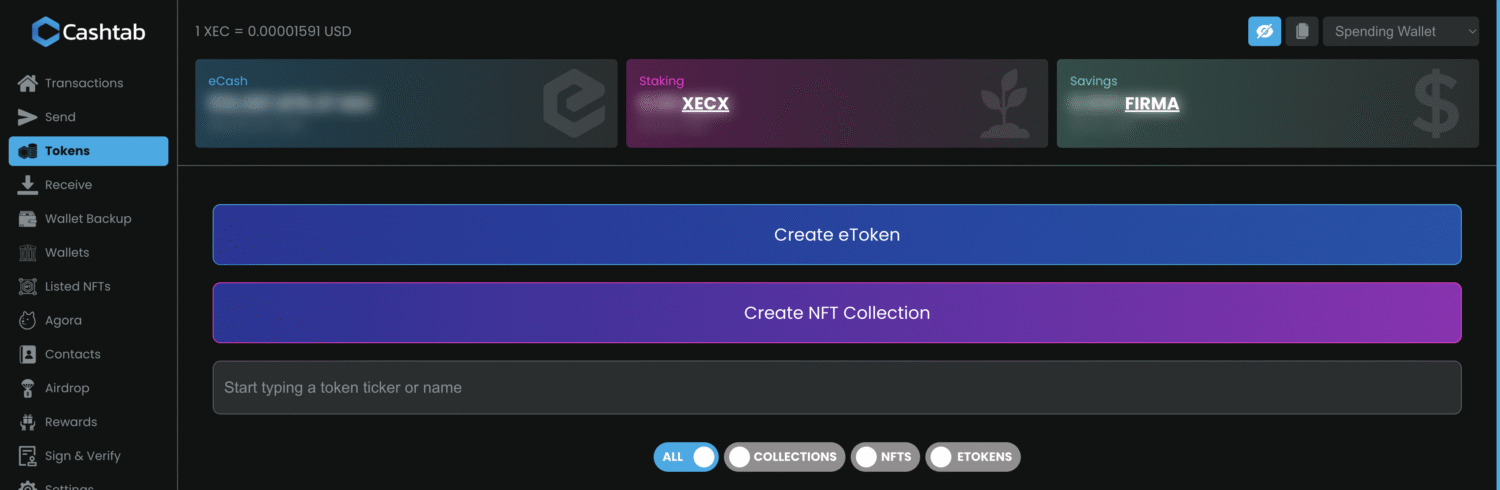
- Go to the Tokens tab and select “Create eToken” (see below for a screenshot).
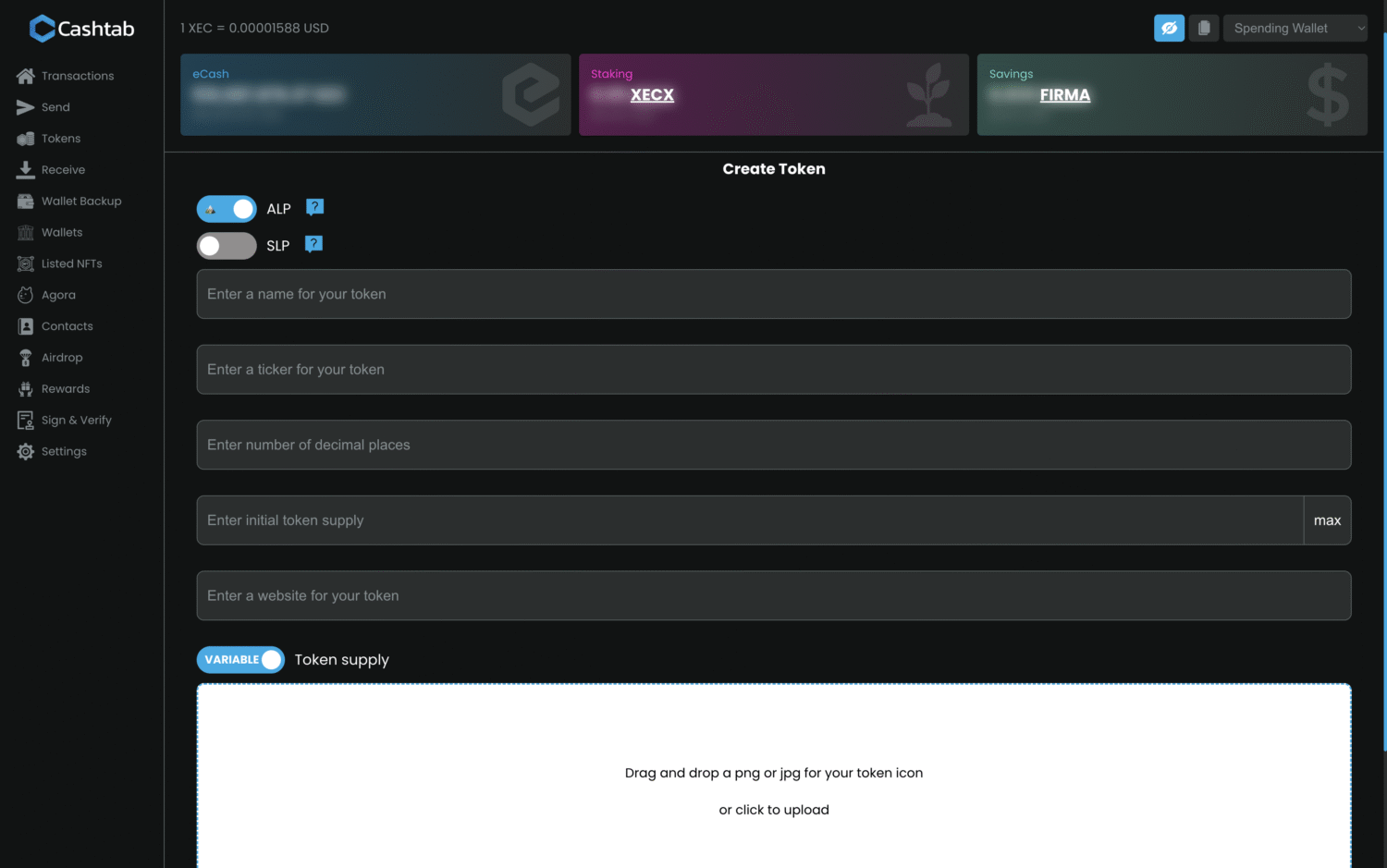
- Complete the following items (see screenshot below to see the fields) and select “Create eToken” to create your token (note: you cannot change this information later, so double-check all information):
- Type of Token (ALP or SLP; ALP is the newer version)
- Token Name (likely a full name, e.g., “Full Name of Token”)
- Token Ticker (likely an all-caps shorter name, e.g., “NICKNAME”)
- Number of Decimal Places (2 to match eCash; may select up to 9)
- Initial Token Supply
- Token Website (if you do not have a site, you can enter cashtab.com)
- Graphic in png or jpg format for your token’s icon
*note: instructions accurate at the time of publication; user interface subject to change
Where the “Create eToken” Button is on the Tokens tab on Cashtab:
A screenshot of the token fields:
Now, let’s talk about recommendations for creating your token:
Recommendations
It’s important to note that you can create any token you want as long as you aren’t:
- pretending to be another coin or token (e.g., Bitcoin, USDT, USDC, FIRMA).
- falsely representing another organization or promising to deliver stuff you won’t, i.e., defrauding or scamming people.
But, if you want your token to see a large number of buyers and holders, you want to have a strategy and a value proposition. Let’s go through those.
Purpose and Value Proposition
First, you need to start with a purpose. What does your token do? Meaning, is it just a meme or a community, or are you trying to raise funds for a cause or a project? The point of your token is the most important thing because it’s the reason why someone would care to buy it. There has to be something in it for them for them in terms of benefits to them or support they wish to provide so that they want to hold some.
You can do many things with tokens, including:
- Charity – Raising money for a cause (example: eCash Inu feeds stray dogs)
- Project – Raising money for an eCash application (example: Star Crystal for Agora.cash)
- Community/Airdrops – Airdropping rewards for community participation
- Memecoin – No intrinsic value; fun and possibly price increases
(Note: I don’t personally recommend investing in memecoins) - Lottery/Raffle – You can have participants opt-in to the opportunity to win a game, competition, or drawing.
(Note: careful with the legality of lotteries in your jurisdiction; I don’t recommend doing anything that breaks the law) - Asset-Backed Token – Token representing a good or service, such as holding staked XEC, U.S. dollars, gold, or other assets (examples: FIRMA, XECX)
Note that, as time goes on, you’ll need to do work to differentiate yourself from other tokens if they have a similar value proposition. For example, if you compete with XECX by providing a staking token, you would have to provide a higher reward percentage, make it more convenient, or make it more transparent. If you compete with FIRMA, you would have to offer a stablecoin in a different currency or some other differentiation. You can’t just offer the same thing and expect to gain marketshare, nor can you expect to do something shady like offering a token that does “everything” or leeches off other tokens (we saw this recently in the community of a token that’s “value proposition” was that it held the equivalent in XECX, which makes no sense since you can just buy XECX directly).
Commitment
Once you identify what you want your token to do, you then have to identify what you are committing to do as part of that token. While a memecoin might just be openly stating that it’s something to buy for fun, the other token purposes require a commitment on your part to deliver against the value proposition. If you ask for funding for a project, you have to give the community project updates. If you ask for charity, you need media showing the impact on the beneficiaries to the benefactors. If it’s a community lottery, raffle, or contest, you need the terms of the game. Most important of all, if it’s an asset-backed token, auditability (the ability to prove that you have what you claim to have) is key to the trust of the token holders.
I know that with the internet being largely anonymous, it can be tempting not to hold yourself to a high ethical standard, but I strongly suggest that you take any promise you make to token buyers seriously. While you might be creating it from anywhere in the world, someone might try to find out who you are if you try to keep the money and not deliver on your promise.
If you have a purpose and value proposition plus your commitment to deliver on anything you promise, you’re ready to then create your token and prepare for launch (e.g., announcement, marketing, campaigns).
Marketing Campaign
If you want to raise money with your token for your purpose, you need to get your token and its mission out there. One option is an Agora.cash listing. Agora.cash is a site for listing your tokens on an exchange-like interface (note: it’s not required to list on Agora.cash, but the Agora marketplace on Cashtab at the time of this post doesn’t have advanced features like premium listings, token descriptions, search, and price history). If you choose to list on Agora.cash, use it to explain what your coin is about and why it might be of interest to the buyer.
Additional channels include:
- Social media (e.g., X, Facebook)
- eCash chat groups (e.g., Telegram eCash Official and eCash Army groups)
- Web site
- Blog post
Again, it’s important that you lead with your purpose and value proposition because there are literally millions of organizations pushing number-go-up messages and looking to capitalize on people who think something sounds good but don’t do too much research. The old clichés of “getting in on the ground floor” or “it’s a movement” or whatever will possibly breed skepticism (as they should).
The most important thing to do to avoid becoming a scam token is to promise something that you cannot/do not deliver. If you avoid that, you can’t become a scam. Be honest, transparent, and fair with what you ask for and what you deliver.
As I’ve created tokens before, I’ll end this post with an example using my own tokens, MEANING and XECITED:
Example: MEANING and XECITED Tokens
Mission: To increase the reach and impact of my book’s (MEANING) and channels’ (MEANING and XECITED) messages
Target Audience: People who want to attract newcomers who can discover and learn about XEC (XECITED) and people who want to help me share content and get reviews, etc. in exchange for money (MEANING and XECITED)
Benefit to the Audience: Airdrops to holders for hitting subscriber, views, hours watched, likes, comments, ratings, reviews, and other social media engagement targets
Commitment: I send the airdrops, create the content, and communicate progress via updates on those numbers against airdrop targets
Marketing Strategy: Create the token on Agora, create an Agora.cash listing, make announcements on X, Telegram, and ProofofWriting.com, and provide updates to the community
Once you’ve created your plan, all you need to do is deliver. Watch how many buyers you get, and make sure to keep everyone engaged. Remember, you are receiving XEC in exchange not just for the token (anyone might buy a few for fun, but not a lot) but for the purpose behind the token. While not every project is successful, being transparent is important no matter what.
Following this approach won’t guarantee that that millions will buy it, but at least a few will if you have something worth buying and they learn about it. Also, note that a bunch of things can go wrong (we all make mistakes), but as long as you don’t mislead people or go back on your word, you can’t do anything harmful. If no one buys it, it just sits there. Fortunately, that’s not the end of the world.
In short, if you have an idea that would benefit from community support, there are plenty of people in the community who will want to help. If you take a sound, ethical approach to creating and offering a token, you at minimum learn a little bit about business and at most possibly develop something that has a real impact on your mission and the eCash ecosystem.