“A poet doesn’t invent his poetry—he finds it,” he said, to no one in particular. “The place,” he added slowly, “where Alph, the sacred river ran—was found out, not invented.”
He looked out the window from where he sat. He seemed to look as far out of the room as he could. “I can’t stand any kind of inventiveness,” he said.
(Excerpted from The Inverted Forest by J.D. Salinger)
There was a time when I couldn’t get enough of J.D. Salinger, the famously reclusive writer of the book The Catcher in the Rye, which still sells a million copies a year to this day.
I loved his writing style. I loved his simple sentences and how they flowed, the way each sentence seemed to pull me into the next, like I was being taken on a journey.
Anyway, among Salinger’s works is a novella titled The Inverted Forest, which is a story about a young girl named Corinne, who can’t erase the memory of a boy she once knew, and what happens when she runs into him many years later.
The reason I bring this all up is because in The Inverted Forest, Salinger wrote that a poet doesn’t invent his poetry, he finds it, and that’s exactly how I felt when I thought I’d finally found the ending to my own novel that I’d been searching for for so long.
For the first time, I’d found an ending that didn’t feel false, because this time I hadn’t invented it. It felt authentic because it was authentic, from my own lived experience, not just something I’d hallucinated.
This all happened at a time when I’d been wondering what I was going to do with my life. I was twenty-seven years old, working a dead end job, and had just come out of another failed relationship.
On the fateful evening I found the ending to my story, I was lying there in my quiet, empty apartment with windows wide open to let in the cool night breeze. I was staring blankly at the white ceiling above me, when I noticed the sounds of the cars passing by outside. It must have rained, because I could hear the wet asphalt as each car got closer, and then further away, one after another, until the constant ebb and flow reminded me of the sounds of the ocean.
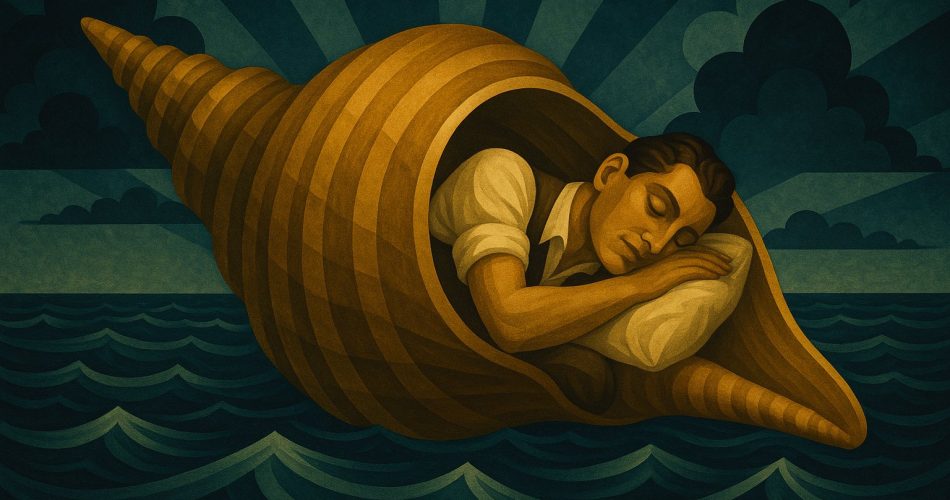
Suddenly, I pictured in mind the image of a man lying inside a giant seashell, surrounded by nothing but smooth white walls and the sound of crashing waves. It was just as Salinger had said, I’d discovered the ending that I’d been looking for. Not invented, but found.
For the first time in a long time, I felt hopeful again. I soon convinced myself that all I needed to do was write an amazing novel and all my problems would be solved. I fantasized about what it would be like to be a best-selling author, maybe even a famous author.
I started running numbers in my head. I figured I had enough money saved to last six months before having to find another job. Maybe a little longer if I maxed out my credit cards, I thought.
Needless to say, I was both delusional and reckless in equal parts.
I remember my supervisor was stunned when I walked into his office and gave my two-weeks notice.
“So where are you going?” he asked.
“I’m not sure,” I said. “I just plan on taking some time off to figure things out.”
He didn’t seem to know what to say after that.
Two weeks later, I said farewell to my coworkers, shook my supervisor’s hand, and walked out of my building for the final time. I had no idea what the future held, but I couldn’t stop smiling as I walked through the lobby and out the double glass doors.
For the first few weeks, I loved my new life. Every day felt like another beautiful day to be alive. I would spend my mornings and evenings writing at home, but during the day, I liked to roam around the city. I visited museums, went to the library, watched movies, hung out in cafes. I knew I had to conserve my money, but it was hard not to take advantage of how much less crowded everything was since everyone else was working.
This was the life, I thought. I could get used to this, I thought, the life of an artist.
I was young, I had a dream, and I had time. But what I didn’t realize yet was that I lacked the one thing I needed most: talent. Each day, I would spend hours writing paragraph after paragraph on my computer, but none of it was any good.
Some nights, I’d stay up late writing into the early morning, convinced that I’d finally cracked it, that the sentences were flowing like I so badly wanted, but inevitably the next day, I would reread what I’d written, only to discover it was the same bad prose as always.
After about a month, I was already thinking I’d made a mistake. Writing a book was going to be much harder than I thought. Not to mention my money was disappearing faster than I’d anticipated. By the end of the second month, I realized there was no way my money was going to last anywhere close to what I’d estimated before, whether I used credit cards or not.
So I started looking for a job. Several weeks went by without even getting so much as an interview. I felt like someone who was quickly running out of quarters to feed the meter, and soon I’d find myself illegally parked. I could see how people become homeless, I thought.
The idea of going to my old supervisor and asking for my job back sent shivers down my spine. Moving back home wasn’t something I wanted to do, either.
But just when I thought all hope was lost, I got a call from a company I’d interviewed with back when I was still employed. Someone I used to work with had recommended me for a position they were trying to fill.
I ended up getting the job, disaster was averted, and I’ve been back in corporate America ever since. But I haven’t given up. I still hope to finish Insomniac’s Dream one day, and until then, I will always have ProofOfWriting.com.
👌👌👌
🙏
Love your wording. ❤️
Thank you.
“Hard work beats talent when talent doesn’t work hard.”
👍
‘Insomniac’s Dream’ is such a cool title. Was just now thinking about what kind of storyline could make a rhetorical oxymoron like that work, and man – is it tough! Reckon something like that would, like the end of your story, have to be ‘found’. Wouldn’t be able to be forced.
And in the meantime, you’re using your talent to take part in the historical struggle to make money the servant, not the master, of humanity. And that’s among the most meaningful quests of which one can partake!
I like the title too =)